Making-Do Townhouse Basement (Pictures)
-
sharward
- Moderator
- Posts: 4281
- Joined: Mon Jan 03, 2005 4:08 pm
- Location: Sacramento, Northern California, USA
- Contact:
-
Rufer
- Posts: 23
- Joined: Thu Dec 30, 2004 7:08 am
- Location: Alexandria, VA
Joist Abilities
Thanks a lot for that information.
I’ve changed the name of my thread for the last time to add a bit of a personal touch and to designate its all-inclusiveness.
The first question I have is whether I can hang my new ceiling on my current joists. I’m a little unsure on how to read the span calculators, so hopefully somebody can help me out. The current floor, what will be above the new ceiling is hard wood and then sub flooring that looks like this: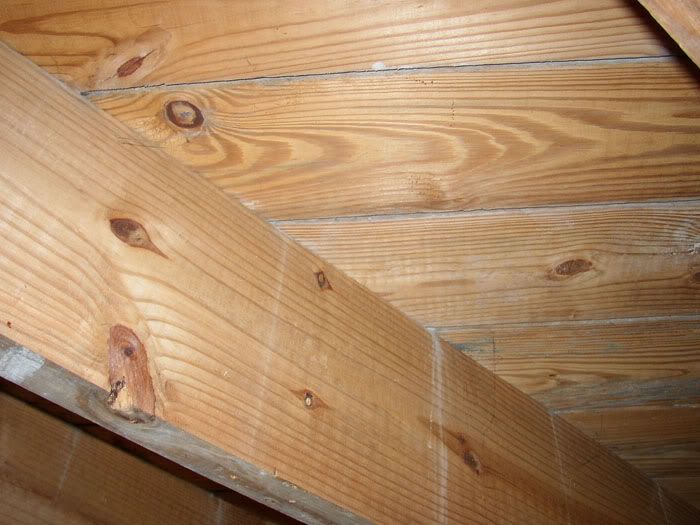
The joists above are 2x10s (but do they really measure 2x9.5”?) and are 16” apart. At the widest point in the room, the joists are 15’ 1” long. I would like to attach 2 layers of 5/8” drywall directly to the sub flooring between the joists and then, hopefully hang 2 layers of drywall from RSIC clips from the existing joists---if they can handle all of that weight. Is there anything else that needs to be known to figure this out?
Finally, the old ceiling had ceiling tiles hanging on furring strips. There are spots along the joists where the furring strips have created depressions. Will these depressions significantly hinder what can be attached to the joists? Thanks again for ALL input.

I’ve changed the name of my thread for the last time to add a bit of a personal touch and to designate its all-inclusiveness.
The first question I have is whether I can hang my new ceiling on my current joists. I’m a little unsure on how to read the span calculators, so hopefully somebody can help me out. The current floor, what will be above the new ceiling is hard wood and then sub flooring that looks like this:
The joists above are 2x10s (but do they really measure 2x9.5”?) and are 16” apart. At the widest point in the room, the joists are 15’ 1” long. I would like to attach 2 layers of 5/8” drywall directly to the sub flooring between the joists and then, hopefully hang 2 layers of drywall from RSIC clips from the existing joists---if they can handle all of that weight. Is there anything else that needs to be known to figure this out?
Finally, the old ceiling had ceiling tiles hanging on furring strips. There are spots along the joists where the furring strips have created depressions. Will these depressions significantly hinder what can be attached to the joists? Thanks again for ALL input.
-
sharward
- Moderator
- Posts: 4281
- Joined: Mon Jan 03, 2005 4:08 pm
- Location: Sacramento, Northern California, USA
- Contact:
Re: Joist Abilities
Try this calculator on the American Wood Council site. It's the one I've been using.Rufer wrote:I’m a little unsure on how to read the span calculators, so hopefully somebody can help me out.
See this nominal-actual lumber size table. The height of your joists (not counting the notched areas) is probably 9 1/4" and their width is probably 1 1/2".The joists above are 2x10s (but do they really measure 2x9.5”?) . . .
You need to establish the species of lumber, the weight of the lumber alone (should be easy to estimate with some Googling), and the weight of your materials. The combination of all of these things is the "dead load." I believe 5/8" drywall weighs about 2.3 pounds per square foot (PSF). You also need to familiarize yourself with live load requirements in the building code your municipality uses. I'm guessing you'd need to account for a live load of 40 PSF.. . . and are 16” apart. At the widest point in the room, the joists are 15’ 1” long. I would like to attach 2 layers of 5/8” drywall directly to the sub flooring between the joists and then, hopefully hang 2 layers of drywall from RSIC clips from the existing joists---if they can handle all of that weight. Is there anything else that needs to be known to figure this out?
See "Understanding Loads and Using Span Tables" on the American Wood Council site.
I learned that my municipality's building code allows for notches no greater than 1/4 the depth on the ends, no greater than 1/6 the depth elsewhere, with no notches allowed in the middle third of the span, where most of the strain will be borne by the span. Although those notches look very small, I would assume that since they appear to also exist in the middle third area that their strength has been compromised. To what extent, I don't know. At the very least you would not want to push their limits. To be totally on the safe side you'd want to consider sistering all the joists with new 2x8s.There are spots along the joists where the furring strips have created depressions. Will these depressions significantly hinder what can be attached to the joists
Doni, the framing guru, what are your thoughts?
-
sharward
- Moderator
- Posts: 4281
- Joined: Mon Jan 03, 2005 4:08 pm
- Location: Sacramento, Northern California, USA
- Contact:
-
Rufer
- Posts: 23
- Joined: Thu Dec 30, 2004 7:08 am
- Location: Alexandria, VA
Well, you're very helpful either way--even if just pointing out things I need to think about. Thanks.
I can't find any stamp on any joist. The house was built in 1955. So, if I can't get the species of wood, I suppose I won't hang anything off of these joists.
But considering these are 2X10's at 16" o.c., I should be okay with two layers of 5/8" gypsum in between the joists against the floor above and I'll interleave new joists? What do you think?
Matt
I can't find any stamp on any joist. The house was built in 1955. So, if I can't get the species of wood, I suppose I won't hang anything off of these joists.
But considering these are 2X10's at 16" o.c., I should be okay with two layers of 5/8" gypsum in between the joists against the floor above and I'll interleave new joists? What do you think?
Matt
-
sharward
- Moderator
- Posts: 4281
- Joined: Mon Jan 03, 2005 4:08 pm
- Location: Sacramento, Northern California, USA
- Contact:
Whether you "hang" it on the bottom of the josts or attach it to the subfloor, you're still adding dead load weight to the structure, so it doesn't really matter.
I'm not saying it shouldn't be done. I am saying that you need to research it to make sure it will be OK. (Basically, that's what you're doing right now! Unfortunately, I'm not the one to write that permission slip for you.
  )
)
Funny how I started out here asking all the questions for my own project, then graduated to "greeting" folks and pointing them to threads that were relevant to their situation, and now I seem to have become the Resident Worry Wart! What's up with that?
Don't tell John -- or he'll change my title from "mere mortal" to "resident worry wart."
--Keith
I'm not saying it shouldn't be done. I am saying that you need to research it to make sure it will be OK. (Basically, that's what you're doing right now!
Unfortunately, I'm not the one to write that permission slip for you. )Funny how I started out here asking all the questions for my own project, then graduated to "greeting" folks and pointing them to threads that were relevant to their situation, and now I seem to have become the Resident Worry Wart!
What's up with that? Don't tell John -- or he'll change my title from "mere mortal" to "resident worry wart."
--Keith
-
Rufer
- Posts: 23
- Joined: Thu Dec 30, 2004 7:08 am
- Location: Alexandria, VA
Yeah, I understand this--it's just that before I was hoping I could attach two sheets to the subfloor AND hang two sheets from the joists. Now, in the absense of knowing the species of the joists, I was thinking surely I can, AT LEAST, attach the sheets to the subfloor if not also hang sheets from the joists. Basically--2x10's at 16" o.c.--certainly any species can handle two sheets.....?sharward wrote:Whether you "hang" it on the bottom of the josts or attach it to the subfloor, you're still adding dead load weight to the structure, so it doesn't really matter.
But yes, I was looking for a permission slip.sharward wrote:I'm not saying it shouldn't be done. I am saying that you need to research it to make sure it will be OK. (Basically, that's what you're doing right now!

-
sharward
- Moderator
- Posts: 4281
- Joined: Mon Jan 03, 2005 4:08 pm
- Location: Sacramento, Northern California, USA
- Contact:
Don't bet on it.Rufer wrote:Basically--2x10's at 16" o.c.--certainly any species can handle two sheets.....?
Here's the thing... Builders tend not to do anything that isn't necessary in order to keep costs down. Wood products are much more expensive and/or of lesser quality these days, so if they can substitute a lesser quality item and still meet code and the minimum architectural requirements, they will do so. If they save a few hundred bucks on a house, multiply that by the hundreds/thousands that are built, and there begins to be a considerable savings.
To be on the safe side, you should assume that the house was built to meet code/spec and nothing more. There's a certain "live load" and "dead load" rating and they generally use the lumber to achieve those numbers. To add two layers of 5/8" drywall increases the dead load by about 5 PSF (pounds per square foot); four layers would be about 10 PSF. If the floor above was built to a 10 PSF dead load and is underloaded by 3 PSF -- a nice margin -- you'd be over limit with the two extra layers. It may not be a problem right away, but get a heavy and temporary live load on that assembly (i.e., a party with many guests all standing in a small area), and you could end up with damaging cracks, or worse, a disasterous failure that may cause injury or death.
The fact that it's an older home may be good in some ways and bad in others. On the plus side,, the lumber may be of better quality (slower growth) than today's stuff. On the minus side, building codes were less strict fifty years ago.
Again, I'm not saying you're a fool for wanting to add weight on that assembly. I am saying you need to consult with a pro to ensure nobody gets flattened.
--Keith
Last edited by sharward on Tue Jan 17, 2006 3:36 pm, edited 1 time in total.
-
DreaminDrumBeats
- Posts: 257
- Joined: Mon Jun 06, 2005 7:15 am
- Location: Wichita, KS
most houses are built with spf ( spruce pine fur ). And for ceiling joists to hang 2 or more sheets of drywall you need 2x12's and depending on how much weight your going to put up on the ceiling joists you would either go 16"o.c. or 12" o.c.
Doni Bieler
Your Local Handyman
Ah man not again. Damn that's gonna hurt
Your Local Handyman
Ah man not again. Damn that's gonna hurt
-
sharward
- Moderator
- Posts: 4281
- Joined: Mon Jan 03, 2005 4:08 pm
- Location: Sacramento, Northern California, USA
- Contact:
Here in California (and I imagine much of the West), I think Douglas Fir is the most common lumber used in residential construction.
"Converting a garage into living space requires a city permit . . . homeowners insurance won't cover a structure that's been changed without a building permit . . ." --Sacramento Bee, May 27, 2006
-
knightfly
- Senior Member
- Posts: 6976
- Joined: Sun Mar 16, 2003 11:11 am
- Location: West Coast, USA
From what I see in the pix, that's #2 and better Douglas fir; for 40/10 load it will span 15'7" using 16" centers at 10# dead load. You'd have about 3 PSF just for framing, another 3.5 for sub and main floor, then adding two 5/8 gyp layers would add another 4.7, for a total of 11.2 PSF (rough estimate) - your spans are a few inches shorter than 15'7", so it would be borderline.
I think I'd use two layers of 1/2" gyp between joists instead, then go with heavier NEW joists so you can get 3 layers of 5/8 on your INNER frame... Steve
I think I'd use two layers of 1/2" gyp between joists instead, then go with heavier NEW joists so you can get 3 layers of 5/8 on your INNER frame... Steve
Soooo, when a Musician dies, do they hear the white noise at the end of the tunnel??!? Hmmmm...
-
Rufer
- Posts: 23
- Joined: Thu Dec 30, 2004 7:08 am
- Location: Alexandria, VA
Thanks for all of the replies thus far.
I've begun beefing up the outer leaf of the ceiling (the subfloor for the room above).
My question is this, when I installed the pieces of sheet between the joists, there are occasionally voids where the pieces butt against each other (some bigger than others). What should I use to fill these voids (joint compound or plaster)? Should acoustic acoustic caulk be used before or after I fill these voids or at all?
Thanks again.
I've begun beefing up the outer leaf of the ceiling (the subfloor for the room above).
My question is this, when I installed the pieces of sheet between the joists, there are occasionally voids where the pieces butt against each other (some bigger than others). What should I use to fill these voids (joint compound or plaster)? Should acoustic acoustic caulk be used before or after I fill these voids or at all?
Thanks again.
-
andy_eade
- Senior Member
- Posts: 345
- Joined: Tue Oct 11, 2005 4:47 am
- Location: Metro Washington DC - USA
- Contact:
Hey Neighbour. Good to see someone in my backyard at a similar stage with a similar project. I am about to start the beef up stage and am out in Herndon VA. Hopefully we can help trade info on local suppliers etc and bounce things off one another...
Best Regards,
Andy
Best Regards,
Andy
That which doesn't kill you makes you stronger... still, wear a hard-hat just in case!
http://www.andreweade.com
http://www.andreweade.com