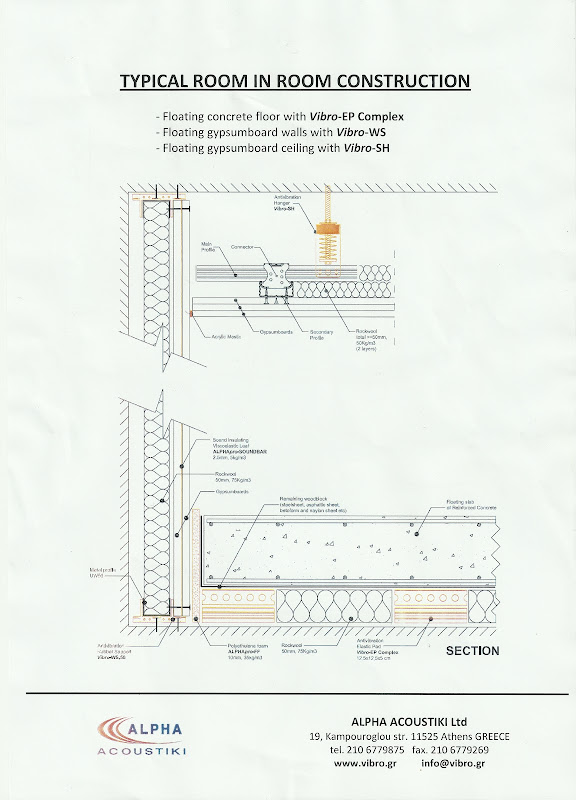
Let me try to understand this: You are taking the word of a salesman who really wants to sell you his product, even though his specifications defy the laws of physics, and you are NOT taking the word of people who really don't care what you do, are not trying to sell you anything, and are just trying to give you good advice? Is that it? And you are doing this after you already got burned by another guy who wanted to sell you his services, even though his specifications also defied the laws of physics, and you ended up having to tear it all down and start again?
Like Brien said: There is no way on this planet that you can get 4Hz isolation with huge, and I mean HUGE amounts of mass: Just take a look at the equations for resonance. They are not complicated, and a simple calculator will show you that what this guy promises you is impossible.
The very best isolated studio in the world is Galaxy Studios, located in Belgium. Their design spec is very similar to what your salesman claims. The natural resonance of their isolation system is set to 3 Hz. But in order to achieve that, they had to do things a bit different from what your salesman is telling you. The control room floor at Galaxy weighs over two hundred and fifty tons! It is supported on 78 specially designed helical steel springs. The entire studio weighs over two THOUSAND tons, and it cost them many, many millions of dollars to build it.
So please, I think you'll forgive me for laughing when some salesman in Greece says he can do the same job for 200 Euros with a bag of rubber pads!!!!


This is what a studio floor spring system looks like when it is tuned to 3 Hz:
galaxy-studio-best-in-world-SPRINGS-PHOTO.png
(Copyright note: I'm not sure, but I believe this photo originally came from Studiotips web site, and in any event it belongs to Eric Desart, who designed those springs).
But this salesman guy goes even better! He not only says that his Euro 200 bag of rubber pads will do the same as Galaxy (3 Hz), but that it will give "frequency reduction till 4Hz", which implies resonance of TWO Hz. (to isolate at a certain frequency, the resonance of the system must be half of that frequency, or less)! So this guy thinks he can get isolation
twice as good as 250 tons of concrete on million-dollar custom designed helical steel springs with elastomer damping, and he can do that on thin rubber pads WITHOUT any mass on top? And you
believe him?
BRIEN: it would take 10 (help me out here Stuart) inches +/- to achieve that.
Let's see now... Concrete density is around 2300 kg/m3, so you'd need about one hundred cubic meters of concrete to get to 230 tons. The room we are talking about has a floor area of about 12 square meters, so you'd only need to make that floor about 8.3 meters thick....

Wait, let me check: 8.3 x 3.5 x 3.4 = 98.88 cubic meters, x 2300 kg/m3 = 227 metric tons. Yup. I got it right.
Hmmmm, I have a feeling the room isn't tall enough to fit that floor in....

Brien told you last time, so I'll tell you this time: You have been taken. Fooled. Had. Conned. Scammed. Fortunately, it was only 200 Euros this time, not 6,000 like last time, but the result is the same.
There's not too many things that make me angry on-line, but such obvious scams are one of them!
I'll give you one last piece of advice: Turn around, run, and get as far away as you can from that guy. Who knows what else he'll try to dump on you, now that he got you to buy into his first hoax. Maybe he'll be telling you about this bridge he has in New York, that he can sell you, real cheap....
I really do not believe they would risk to lie to me for their products.
Tell you what: Send an e-mail to Eric Desart, and ask him about that. Eric is the guy who designed Galaxy, and did the calculations for those giant springs with massive concrete floors. He's one of the most respected acousticians in the world, and he even posts here on this forum sometimes, so his e-mail address and PM access are available to you. Just send him a message, and ask him if he agrees that rubber pads without any mass on top can isolate a room down to 4 Hz.
Or send an e-mail to any of the other world-class professional studio designers here on the forum, such as Glenn, Andre, Rod or John himself, and as if they agree that rubber pads with no mass can isolate a floor down to 4 Hz.
I guarantee you that you will NOT find anyone to support that notion, since the claims made by your salesman defy the laws of physics.
I think you should also take in consideration that there is different architecture/manufacture of Greek buildings are not similar to US buildings
Perhaps, but the laws of physics and acoustics are the same, everywhere in the entire universe. It doesn't matter if you live in the USA, Chile or Greece, the universal laws that govern how the universe works are the same everywhere, including the laws of acoustics. And those laws make it absolutely, totally, and entirely
impossible to float a low-mass studio floor on thin rubber pads and achieve isolation down to 4 Hz.
The concrete foundations/slabs are all "connected" with all the concrete columns/rebars of the whole building.
Just like where I live! That's how we build things here, because of the earthquakes. Chile has suffered the largest earthquake ever recorded, plus several others on the "top ten" list, so we learned the hard way how to build structures that can withstand that. So yes, concrete and rebar buildings are rather common here. And when I was involved in the construction of one of the top studios in Santiago many years ago, which they built on the SECOND floor (not ground floor) of such a building, they floated it with massive amounts of concrete on resilient supports. And it cost them a fortune. Maybe I should call them up and ask them if they would like to replace all that with a bag full of 200 dollar rubber pads, and some sheets of plywood...
Construction doesn't matter: the laws of physics matter. The equations and formula matter. There is no construction technique, or construction material, that can change the laws of physics. Sound and vibration work exactly the same here where I live, as they do where you live, and where Brien lives. Anyone who tries to tell you different is a liar, plain and simple. Using concrete and rebar doesn't change anything (and I'm pretty sure that Brien understands concrete and rebar even better than I do!). Sound still behaves the same.
The point is, what you NEED for your room is NOT million dollar floating floor springs, and certainly not a 200 Euro bag of rubber pads, but isolation. Isolation is achieved by mass, by tuning, and by decoupling. The main issue is NOT your floor: it is your DOOR, and you haven't even mentioned what you plan to do about that. The next major problem is your WALLS and CEILING (they go together). Then after that you biggest problem is your HVAC system (ventilation): And only then, in last place, is your floor. It is the least important of all, since it is a concrete slab sitting on top of the ground. So it already has lots of mass, and it already has lots of damping (the dirt underneath). It is already isolating well.
So let me clarify: The problem with concrete-and-rebar construction is flanking noise, not air-borne noise. The problem is things that impact (bang into) the floor. There is a large amount of mass in the concrete, so souns that are in the air CANNOT make it vibrate. The ONLY thing that can make it vibrate, is direct impact. The way to stop impact noise from getting into the floor, is NOT to float the entire floor: that isn't even the purpose for floating a floor. The solution is simply to decouple. That just means to stop things form hitting it! Very, very simple. That's what a drum riser does: it decoupled the drum kit form the floor. It is NOT a floating floor, and doesn't pretend to be one. It is NOT a resonant system, and in fact is designed to resonate as little as possible, and at a relatively high frequency, NOT a low one. It simply stops the drum kit from touching the floor, and absorbs the impact.
I showed you one way of building one very cheaply, based on mineral wool, and the only objection that your "expert" salesman had to that plan, was that you might have to replace the mineral wool in five or ten years!


So big deal: if you are still using that room ten years from now, and you start noticing that the mineral wool needs replacing, then go to your local hardware store, spend a few euros (but a lot less than 200!), and buy some new mineral wool. And that's assuming that this supposed "compressive stress" that affects Greek mineral wool happens to strike yours! But it is rather curios that your salesman would mention something about "compressive stress in mineral wool", when I never even suggested mineral wool for building your drum riser: I specifically told you to use OC-703, which is NOT mineral wool. So there are only two possibilities: either your salesman doesn't have a clue what OC-703 is, or he does know and just pretended to be ignorant, so he could lie to you...
Or if you really cant stand the thought that you might have to spend a few euros on new mineral wool (or OC-703) in ten years, then don't build it that way! There are MANY ways of building drum risers. You could probably build a great one using Sorbothane for the decoupling, or EPDM, or neoprene, or several other possibilities.
But anyway, if you insist on floating your floor, even after reading IR-802 (which I gave you links to several times), then I think you'll be on your own as far as I'm concerned. So all I can say, is good luck with your build.
- Stuart -
Edited to add: I just looked at the web site for those pads: the guy was NOT telling the truth to you when he said you didn't need concrete for them. Read what their very own website says:
"It can be placed under the metal supports of machinery or
under concrete floating inertia supports, in single or multiple layers.": Only two options here: You can use those pads to float heavy machinery OR you can use them to float CONCRETE inertial supports.
It doesn't say anything at all about using them to float a drum kit....
Did you READ the specs? Did you understand the table that shows you what load factors you need to apply in order to make it float? Did you read what these things are meant for?
Here, I'll paste it for you:
SUITABLE FOR LARGE LOADS
APPLICATIONS
ANTIVIBRATION SUPPORTS:
Air-compressors - Air conditioning units – Pumps – Fans – Generator sets – Cutting machines etc.
FLOATING SUPPORTS:
Industrial floors – Elevators – Printing machines – Testing machines etc.
do you
Do you see any place there where is says you can use them to float a sheet of plywood with a drum kit on top? These things are design for "LARGE LOADS"! Read it again. Do you have any idea how much a large generator or printing press weighs? Do you know that an "industrial floor" is? Here's a hint: it is not a sheet of plywood with a drum kit on top!
Plain and simple: the salesman lied to you if he said that you don't need any mass. Their very own web site proves that. Just like with all heavy-duty resonant isolation systems, you need a LOT of mass if you want that to work. And the salesman also misrepresented what the web site said about isolating down to 4 Hz. Read it again, and see if you can figure out how he misinformed you there, too....
In other words, I'm sure the products work as advertised, but what they salesman told you is very, very different from what the web site says....