The depth of soffits isn't critical, as they contribute nothing acoustically other than a place to mount your speakers. The speakers should be a relatively snug fit, unless you intend to try different speakers, in which case you should make the recesses big enough for the largest speaker you intend to use, and then make individual front baffle extensions for each speaker. The goal here is to make the speaker think that its front baffle has been extended, and we do that by having the front baffle of the speaker effectively one plane aligned with the wall.
As to using the lower and/or top areas for traps, you would just build the trap in, using the available dimensions and construction techniques found on the SAE site, here if you've not already found it -
http://www.saecollege.de/reference_material/index.html
Remember that baffle extensions should be as rigid as you can make them so they don't flex with low frequencies, and that, one way or another, the speakers should have a very narrow gap around them which is stuffed with insulation, and they should be exactly flush with the front edge of the soffit so that acoustically the entire front looks like one piece.
Speakers should, if possible, be set so that the midpoint between woofer and tweeter (unless it's a 3-way) are at ear level - if that's not possible, for example because you're using both soffited mains AND nearfields, then the non-ear-level speakers should be tilted so that the midpoint of the front baffle is PERPENDICULAR to a line drawn from that midpoint to the ear of the mix engineer. Keep in mind that doing this can introduce even MORE problems with early reflections, the geometry of this can be a real bitch.
Control room windows are a major pain - they are (acoustically) reflective right where you need absorption, they have glare right where you need to see, they compromise walls that need high isolation, they break when you "accidentally" throw a weighted mic stand at them, the right kind of glass costs a small fortune, especially with the mic stand thing... :=) In other words, a definite PITA. For this reason, IMO, the smaller the better. I could live with a 2' x 3' window and a couple of CCTV setups and be happy, but I'm kind of a mole when I'm creating. I would think that 3' x 5' should be the LARGEST window to consider, unless you've got a big SSL desk and just want ALL of it to reflect back to clients in a big window...
You don't need as much distance between the two glasses in a control room window as you've shown - if the distance between finish wall surfaces from tracking to control room is, say, 10 inches then that's plenty of air between glasses. So, if the glass to glass distance can be less, and the window can be smaller, then you've just gotten more area for soffit fronts...
Splaying the glasses is another argument - it's said that any gain in flutter control is lost in Transmission Loss because of decreased air space. About the only thing that's agreed on is the improvement in glare, which could theoretically be controlled by lighting design.
Glass thickness, in order to come as close as possible to wall performance, should be about 1/3 the thickness of total layers of wall paneling on each leaf, assuming sheet rock. You want roughly the same mass, and glass is about 3 times the weight of sheet rock.
BTW, you can download a free trial copy of smartdraw here -
http://www.smartdraw.com/
It obviously has limitations, or it wouldn't be free, but hey... Steve
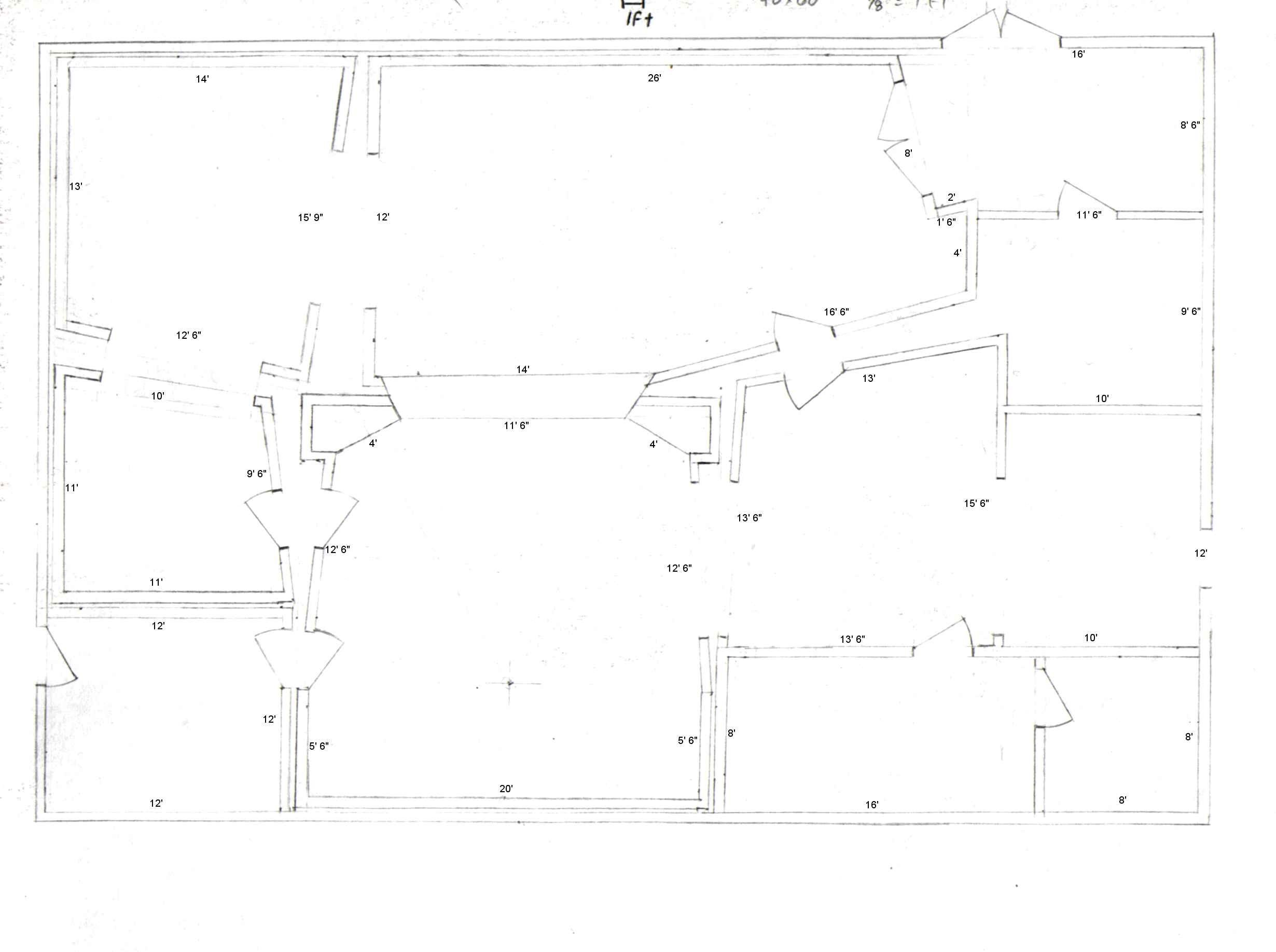
 Just for kicks... Anyway, pick it apart, please!
 ), so it's possible that I can move the work shop up-stairs and make a "Studio C", but I would do mostly drums and the rest scratch tracks, and I think that can be accomplished in 3 rooms, but you do bring up a good point to be considered... I have a copy of that file that has room dimension, I know my little cheesy |-| = 1ft doesn't give you a good idea of scale. It's bigger than you would want to put on the forums, but maybe I'll put it up on a page and ship out a link. Would you be interested?