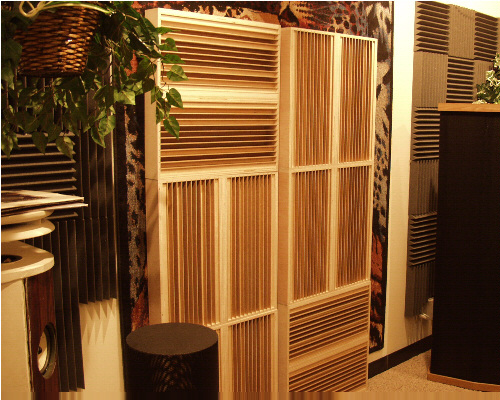
The idea came from another post, either here or at recording.org, and I can't find it now. If anyone does find it, please link it here, even if just to give the guy credit for his idea.
I had a lot of leftovers and scraps from building the wall systems, so I made as many 6" wide by 24" long pieces as I could out of 3/4" OSB and 1x6 (the 1x6 has been a lot better, but I had more of the OSB scrap). Then, using a band-saw with the table set to a 30 degree angle, I cut a wave shape into it to get these...

With me so far? Ok, once I had these (a LOT of these...) I used 1x2 and 1x4 as a frame to hold 12 of these together, with about 1" to 1-1/2" space between the slats, to make a 24"x24" square panel. I kept the angled faces alternating directions, and tried to keep the wave peaks from lining up. Here's the result...

Now, all that remains is to hang them. I had mounted 2x2s to the ceiling, but they didn't give me enough room to attach the panels so I ended up having to double them up. But after drilling pilot holes thru the 1x4 frames, they went up real easy. I alternated the direction of the slats on each panel. Not all of the ceiling is done yet, but it's over the mix position to keep that flat drywall from shooting early reflections right at me, and it works great.

My wife thinks it looks like bad dental work. My band thinks it looks like some Machiavellian torture device. All my clients think it's the strangest ceiling they've ever seen.
It takes a lot of time to put together, but it's not terrible. A lot of time with the band saw, and a lot of time screwing them together. My prime complaint about assembling them is that I used OSB, because I had a lot of it- but it's not really suited to end-fastening, even with screws, so I had to pre-drill every hole and be very careful to not split them. Many slats got thrown out. Using 2x lumber would have been easier to assemble, and would require fewer slats- I'm thinking of switching on the remainder of the ceiling. They'd just be heavier, and take a little more effort to hang up.
I'm sure QRD diffusors would be a little more effective as diffusors, but this is an awfully random surface I have here- and you'd have to be a lot more talented with a band-saw than I am to get all those waves to be identical.
I have a theory of using these on the walls, as well, especially for a rectangular room. If I were to use these on the side walls of a control room, for example, but with all of the slats oriented vertically, and with the 30 degree faces toward the back of the room, they would create the same effect as splaying the side walls 30 degrees. Even if I didn't cut the wave-shape into them, I could just run 2x4s across a table-saw with the blade angled- they wouldn't diffuse vertically, but they'd still direct sound to the rear wall and add some diffusion from the spaces between them. If I were to build the major walls inside-out style, with fiberglass blanket insulation in the stud spaces, 703 over that, and these slats over the top of that, in theory it'd be a pretty good sidewall: Sound hitting between the slats would be absorbed, and sound hitting their faces would be directed to the rear wall. It'd sure make the rest of the room easier to build. And since a lot of studio walls use wood slats of some sort, this isn't a very long step from common practice.
Just thinking out loud. Let me know what your opinions are...