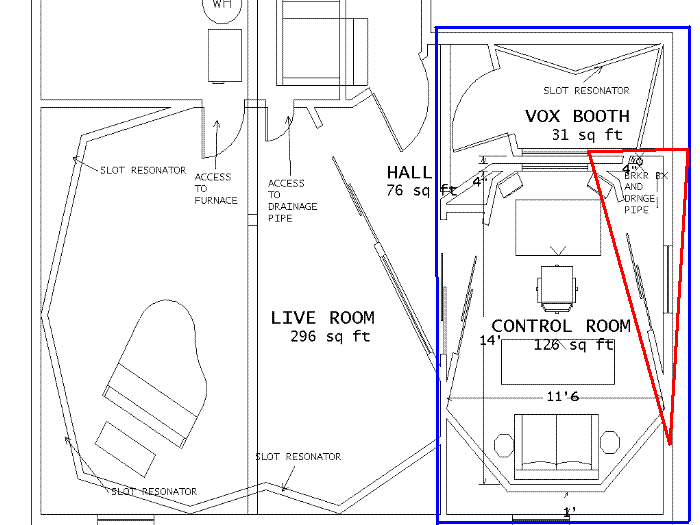
Here is a layout the Doni (DreaminDrumBeats) helped me out with.
The first phase of contruction is the area outlined in blue.
I am a little confused though. You can see in the area highlighted in red that I have an electrical breaker box and a window that I am going to access through a slider. Does the wall with the slider become the inner leaf. Or do I build the room within the room and then add the angled walls.
I have searched though tons of posts and I am unable to find the answer.
I feel your pain; to simplify, the answer is a definite probable maybe.
OK, all seriousness aside - it depends on your wall construction. I'll try to explain -
The ideal way to build a studio would be to build a doublewall containment structure, so that you have a mass-air-mass system between you and the world; then, you would proceed to make the space inside that structure "sound good" - this would typically be done with various acoustic treatments, wall angles, etc -
If your inner, angled walls are NOT perforated in some way (such as slat resonators, perforated panel traps, etc) then they WILL contribute to degradation of your isolation by means of the multi-leaf effect - if you're aware of this you can "beef up" your outer two leaves to compensate for the loss in isolation at lower frequencies that would be caused by an extra, splayed, leaf. Even panel type bass traps will cause a weakening of your double leaf wall where the trap is located.
I don't have any formulas for figuring out just how much this affects things, and haven't seen anything offered by some of the less "math challenged" of our members.
In a LESS than ideal world, your inner, splayed walls may need to do "double duty" - their isolation value will be determined by their SMALLEST air space combined with the masses of each leaf, so a splayed inner wall that is the second leaf, if the air gap goes from 6" to 18" along the length of the wall your isolation will be determined by the 6" depth, NOT the 18" depth. Under these conditions, BOTH the outer leaf and the inner, splayed leaf, must be hermetically sealed for decent isolation.
For flutter control, splaying walls by 6 degrees each side has been found by John to be enough; for reflection control in creating an RFZ control room, both the front, sides, and ceiling must be figured out geometrically so that there are no early reflection points that result in a sound path to your ears that isn't at LEAST 20 feet LONGER than the direct path from either speaker to your ears. So, if the direct path from a speaker to your ears is 6 feet, then the first reflection you hear should be a path length that's at least 26 feet long.
This normally requires some form of Ray Tracing to do, and even then in most control rooms the rear must be heavily trapped as well as "clouds" on the ceiling - for 5.1 rooms, this gets even trickier and requires more absorption than a STereo room.
Basically, to figure out an isolation system you just pretend to be a sound, and "try" to get from one place to the other; if you must travel thru some mass, then an air/insulation space, then a second mass in order to get there, you're just right. For sound isolation purposes, anything you can't BLOW through is MASS; anything you CAN blow through is "air" - so most rigid "foam" insulations are MASS, even though they're very POOR mass. Each type of material will have different characteristics that change how the wall performs.
Gettin' near 4 am, so I'll have to go for now; HTH... Steve
Soooo, when a Musician dies, do they hear the white noise at the end of the tunnel??!? Hmmmm...
Thanks Steve, I had to read that twice to start to figure it out. It looks like a will need to read it a couple more times to be sure.
Basically you're saying it could act as the 2nd leaf as long as it is a beefy mass wall and it is air tight to the outer leaf.
Am I on the right track.
If so, what do I do about the vapour barrier on the outer leaf? I was planning on taking it down bsed on your info from my other post and put on the inner leaf before the drywall. Would I still do this. And could I cover it up in a loose fabric to make it look a little better as it will be seen through the slider door.
I Annoy wrote:Basically you're saying it could act as the 2nd leaf as long as it is a beefy mass wall and it is air tight to the outer leaf.
Am I on the right track.
I think what he's saying is that it would technically be three leaf, which as you know is in the "bad" category... But you can compensate for the badness by adding mass to the other two leaves. So, in the grand scheme of things, you have a minus, but you make up for it by having some pluses in the equation.
That may be what you meant... I just wanted to clarify so that we aren't fooling ourselves into thinking that it's not three leaf.
If so, what do I do about the vapour barrier on the outer leaf?
I'm not ignoring this part of your post... But I'm still in "learning" mode on that topic and will be researching it on my own over the next couple of days for my own project. Do a search on "vapor" and you'll likely find much of the same stuff I'll be looking at.
I recommend reading some of these articles (thanks knightfly for the link on some other post), it's a quick way to get up to speed on the subject. And the articles are mostly extremely well written for this type of material.