Hello, i've just been reading throught the chapter in Rod's book and I wonder which mic is recommended to capture honest test results in room testing applications?
Also, will the progeram ETF provide audio test signals? otherwise, where do you recommend me getting them?
I'm about to measure and calibrate my room and I wonder, as i've not got any experience on the topic from before, how much of a variation freqwise is normal for a room, untreated and treated? How much variations can I accept in a controlroom? am I able to tune the room to +-3dB 20-20k or even +-1 dB 20-20k or what could I expect?
Osse wrote:how much of a variation freqwise is normal for a room, untreated and treated?
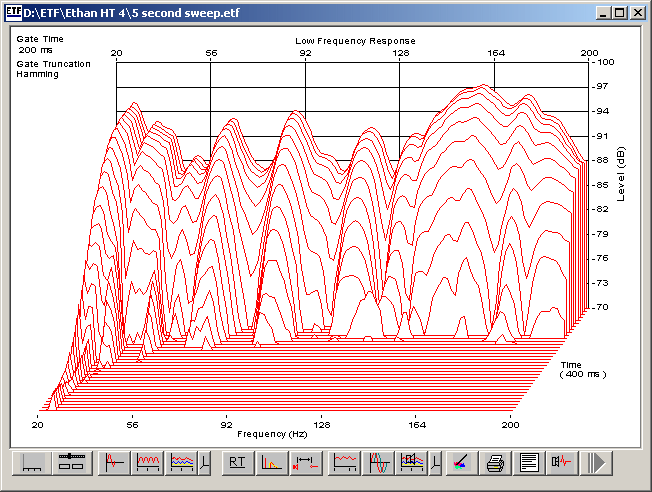
It depends a lot on the size of the room, and of course the quality of your loudspeakers. Good speakers in an untreated room the size you'll find in most homes will vary by at least 30 dB, with numerous peaks and deep nulls throughout the bass range. With a lot of bass traps you can get that down to a 10 dB span. Bass traps also broaden the bandwidth of peaks, which helps further, and they also reduce ringing decay times which is equally useful. But you'll never get to within a 3 dB window unless the room is very large and very well treated with bass traps. The graph below shows the low frequency response and ringing I measured in my 25' by 16' living room when I had 38 bass traps and other acoustic panels. I now have 54 panels (four are diffusors), and one of these days I'll measure again. But I bet it's still not within a 3 dB window.