Low end troubles ...

How to use REW, What is a Bass Trap, a diffuser, the speed of sound, etc.

Moderators: Aaronw, sharward

r.baby
Posts: 11
Joined: Thu Sep 01, 2005 4:11 am
Location: Denmark

Low end troubles ...

Post by r.baby »

Right. I'm new here, be gentle with me! :-)

I've got a bass problem. Actually, I've got three. I've got a nasty 8dB buildup from 30 to 60 hz in the right side og my room, and some dips around 125 hz and 150 hz. The room is weird. My setup isn't ideal. I know all that. But I can't change it, so I need to do some acoustic treatment to at least somewhat remedy the problems.

I'm attaching a freq response readout and some sketches of the room, as well as a photo of me smiling (which is rare, and it does look fake, I know. It IS fake, actually) in front of the setup, and one of the nasty corner.

If you look at the floorplan, you'll notice there's a bit of free space between the sidewall and the right speaker. There's actually something like 57x78x12 (H,W,D) inches of nothingness there to be used for a bass trap. Also, under the control room window, there's a circa 33x47x8 inches slot for even more treatment.

So. The main question is: How do I control the wide q 45 hz boost to the right? I'm thinking a flat panel absorber, but I'm having a hard time actually finding some info on dimensions etc for this particular (and nastily deep) freq. Also: what about the dips around 125-150? They are quite obviously caused by reflections from the tilted ceiling, but is there a cure?

Any help will be MUCH appreciated!!!

best regards,

Flemming Bloch
Mindless Studio
Aarhus, Denmark
knightfly
Senior Member
Posts: 6976
Joined: Sun Mar 16, 2003 11:11 am
Location: West Coast, USA

Post by knightfly »

Just some quick stuff -

When you give directions of left and right, are you referring to them as you'd see it from the mix position, or as we are looking at your floor plan?

Is there no way you can re-arrange things to get a more symmetrical mix position - wall same distance from either speaker, etc - IOW, plane symmetry relative to a vertical plane passing halfway between speakers and bisecting your head ?

The sloped ceiling would be much better in front of your mix position, so early reflections would be directed away from you (RFZ)

Actually, 8 dB isn't all that deep; we've had members with 20-25 dB dips/peaks. Although your room is odd-shaped, some of the info here

http://www.johnlsayers.com/phpBB2/viewtopic.php?p=18059

might possibly help.

Generally, what works best is to first concentrate on locations til problem modes are minimised, THEN add treatment to smooth out whatever's left.

If the boost you're getting is coming from the side where the speaker is closer to the wall, that could be most of your problem (forcing the speaker into 2 pi space more or less)

It's 3 am here and my roofing crew is due at 8, so gotta cut this short for now; at least we got a start... :? Steve
Soooo, when a Musician dies, do they hear the white noise at the end of the tunnel??!? Hmmmm...
r.baby
Posts: 11
Joined: Thu Sep 01, 2005 4:11 am
Location: Denmark

Post by r.baby »

Hi Steve, and thanks! :-)
knightfly wrote:When you give directions of left and right, are you referring to them as you'd see it from the mix position, or as we are looking at your floor plan?
As seen from the mix position. Sorry, should have included that.
knightfly wrote:Is there no way you can re-arrange things to get a more symmetrical mix position - wall same distance from either speaker, etc - IOW, plane symmetry relative to a vertical plane passing halfway between speakers and bisecting your head ?

The sloped ceiling would be much better in front of your mix position, so early reflections would be directed away from you (RFZ)
No, I can't. I wish I could, but there are several reasons that I can't. You see that white metal beam that's holding up the roof? There's another one of those behind the current listening position, and if I turned the whole setup around, that beam would be right slap bang in the middle of where the right speaker would go, unless I decided to push the setup up toward the current control room window-wall, which would give me the same low end problem, only with the left speaker instead (seeing that it would be in the exact same spot as the current right speaker). Also, I've got a lot of stuff in this room, and this is the layout where everything actually fits without feeling cramped – quite important since it IS a working studio, not just a glorified listening position. Sigh. Studio layout is an uphill battle of compromises, let's face it. :-(
knightfly wrote:If the boost you're getting is coming from the side where the speaker is closer to the wall, that could be most of your problem (forcing the speaker into 2 pi space more or less)
Steve
Yeah, that's my feeling too. That's why I was thinking about doing a low freq absorber there. The only real problems in the room seem to be those three low freq areas (the wide boost around 45, and the dips up around 100), and as you say, it's not like it's HORRIBLY bad as it is, but it would be nice if I could level it out a bit more. Just to be on the safe side. I have noticed that when going to mastering, my mixes always tend to have a bit too much low end (which prolly is caused by the two dips), and a rather undefined sub bass (which would translate into the wide 45 hz boost, right?). I mean, if it's not really possible to fix it, I CAN live with it as it is, it would just be nice if there was a fix ... :-)

I'll check the link now! Thanks again! :-)

best regards,

Flemming
r.baby
Posts: 11
Joined: Thu Sep 01, 2005 4:11 am
Location: Denmark

Post by r.baby »

Ah. Already read that thread! :-)

Thing is, that chart doesn't really apply to my room, does it? What, with all it's quirks and weird angles.

Flemming
drfrankencopter
Posts: 186
Joined: Sun Apr 03, 2005 1:09 am
Location: Ottawa, Canada

Post by drfrankencopter »

The dips may be deeper than 8dB...try a smaller FFT size, it makes for a less smooth graph, but can resolve sharp peaks and dips.

The basss buildup on the right side (from mix erspective) would be caused by having the monitor located effectively in a tricorner. The left one is almost in free space, and the right is corner loaded, and thus has a shelf type bass boost (is it 12 dB boost for a true tricorner? I see about 10 dB increase on your graph).

The good news is that you can compensate for the corner effect with EQ. Or, if your monitors have acoustic correction networks in them, adjust the right one for the corner position.

For the other dips, again, try smaller FFTs to get better precision, and then build traps to suit. Looks to me like a trap targetted at around 100Hz would do you alot of good.

Cheers,

Kris
r.baby
Posts: 11
Joined: Thu Sep 01, 2005 4:11 am
Location: Denmark

Post by r.baby »

Hi Kris, and thanks for yuor comments :-)
drfrankencopter wrote:The good news is that you can compensate for the corner effect with EQ.
Say what?? EQ??? Are you serious? It's not the speakers that are adding the extra low end, it's the room. How can I eq my way of that? Also, wouldn't doing some quite drastic wide q eq'ing at 45 hz affect the signal at other frequencies too?

Honestly, I'd very very much prefer not having to change what I'm sending to my speakers. If it's in any way possible, it ought to be better to 'fix the room', right?

quote="drfrankencopter"]
For the other dips, again, try smaller FFTs to get better precision, and then build traps to suit. Looks to me like a trap targetted at around 100Hz would do you alot of good.
[/quote]

Yeah, with a semi wide q. So ... how would I make such a trap? :-)

Best regards,

Flemming
drfrankencopter
Posts: 186
Joined: Sun Apr 03, 2005 1:09 am
Location: Ottawa, Canada

Post by drfrankencopter »

Say what?? EQ??? Are you serious?
Yes, quite serious.

What do you think acoustic correction networks are? They're just EQ. I understand and appreciate your reluctance to EQ your monitors, but it can be the most effective fix for a certain set of problems. As it happens, speaker/boundary loading issues can be solved by EQ, and that's what I think is causing your low frequency buildup around 45 Hz on the right side.

What you can't fix with EQ is problems relating to room modes themselves, because the amount of EQ neeed to correct for the room will change depending on the location of the listening position. Those problems (i.e. mode problems) are best left to acoustic solutions like absorbers/bass traps.

Feel free to not EQ, but I'll say this, no amount of bass trapping is going to solve the bass bump introduced by corner loading your monitor.
Yeah, with a semi wide q. So ... how would I make such a trap?
There are lots of plans available on this site...slat abosrbers, panel absorbers, Helmholtz etc. Find one that you think you can build best, and that will work with your room setup/available building materials, and make it. Most traps that have fiberglass fill will have a fairly wide Q, and should work for your app, you just need to set the depth to target the 100Hz range.

Cheers,

Kris
r.baby
Posts: 11
Joined: Thu Sep 01, 2005 4:11 am
Location: Denmark

Post by r.baby »

drfrankencopter wrote:What you can't fix with EQ is problems relating to room modes themselves, because the amount of EQ neeed to correct for the room will change depending on the location of the listening position. Those problems (i.e. mode problems) are best left to acoustic solutions like absorbers/bass traps.
Hi Kris

That's what I thought too. I'll have a look around for bass traps here. I've already looked quite a bit and haven't found any actual info on how to, though. Maybe I'm just stupid. Sigh.

:-)

Flemming
r.baby
Posts: 11
Joined: Thu Sep 01, 2005 4:11 am
Location: Denmark

Post by r.baby »

Just to focus in on the possible (instead of dreaming of the unreachable, hehe), I've got two 'slots' available for bass trap placement. Well, three, actually:

•One to the right of the right speaker, on the side wall. Its dimensions are 57x78x12 (H,W,D) in inches.
•One is behind the right speaker on the front wall, it's roughly 40x15x8 inches.
•And one is underneither the control room window, between the speakers, 33x47x8 inches.

Alternatively, the whole corner behind the right speaker could be filled up with some sort of trap, but that would lose the second 'slot', and would make the first one quite a bit less wide.


I realize that this is rather limited, but it's the best I can do. I'm still hoping that someone could come up with a magical suggestion wherein slots 1 and 2 could be used (if only partially) to remedy the 45 hz boost, and slot 4 could be used for the dips up above 100 hz. I have NO clue how to do the maths and even if I had I have to admit to being rather poor at maths. So please, if you've got any suggestions, explain it to me as if you were talking to a two year old. A rather stupid two year old, at that! :-)

luv,

Flemming
drfrankencopter
Posts: 186
Joined: Sun Apr 03, 2005 1:09 am
Location: Ottawa, Canada

Post by drfrankencopter »

Sorry Flemming, I'm not going to do all your homework for you, but here's a place to start:

Panel Trap post on Ethan Winner's forum

Also, here's Ethan's well written article on how to build a bass trap (panel trap, which is probably what you want).

http://www.ethanwiner.com/basstrap.html

As far as your 'slots' are concerned, don't bother with the ones behind the right speaker. Use your EQ to fix the loading problem first. You can't fix your 45Hz right side boost with traps....they are best used to add damping to solve mode problems, and your boost is not likely a mode problem. To prove it, move your mic around and see if the 45 Hz boost remains....if it does, it can be fixed by EQ. If it cancels out and becomes a dip at certain locations, then voila it's a mode issue.

For trap locations, consider right above the mix position, front wall, and immediately left/right of the mix position. Try to keep your trapping symmetrical.

Cheers,

Kris
knightfly
Senior Member
Posts: 6976
Joined: Sun Mar 16, 2003 11:11 am
Location: West Coast, USA

Post by knightfly »

Got your PM, decided to answer publicly for continuity - Actually, I tend to agree with Kris -

The thing to remember here is that your right speaker really IS effectively in a tri-corner, and therefore WILL put out quite a bit more bottom end - even Genelec gives you "response" switches for half and quarter space - these are nothing more than a shelving EQ at 6 and 12 dB CUT, to be used when the speaker is in a corner (6 dB) or in a 3-way corner (12 dB)

As far as other routes, you will want thick absorption (like 3PCF fiberglass or rockwool) between your speakers and nearest boundaries to help smooth out SBIR problems - but as Kris pointed out, because this is VERY likely to be speaker/boundary related (as opposed to room modes/standing waves related) it CAN be addressed with EQ, and likely WILL need to be.

The thick absorbent will help other, less obvious peaks/nulls caused by SBIR, but short of re-designing your room for a symmetrical mix position, using whatever loading switches your speakers have is IMHO a valid approach.

Anything else you might be able to do to get better symmetry would be a good thing to do also; such as portable gobo's or absorbers used during mixdown.

I agree with you that it's difficult to force yourself to purposely "unbalance" your stereo feeds, etc; it just seems WRONG somehow - but so is your (VERY) un-symmetrical mix position; personally, I'd give the EQ thing a shot. IF it doesn't work, how hard can it be to un-do?

Sorry for the delay, BTW; got stuck covering two extra 12-hour graveyard shifts so I'm pretty much just eat/sleep/drive/work/repeat for the moment... Steve
Soooo, when a Musician dies, do they hear the white noise at the end of the tunnel??!? Hmmmm...
r.baby
Posts: 11
Joined: Thu Sep 01, 2005 4:11 am
Location: Denmark

Post by r.baby »

knightfly wrote:As far as other routes, you will want thick absorption (like 3PCF fiberglass or rockwool) between your speakers and nearest boundaries to help smooth out SBIR problems - but as Kris pointed out, because this is VERY likely to be speaker/boundary related (as opposed to room modes/standing waves related) it CAN be addressed with EQ, and likely WILL need to be.

The thick absorbent will help other, less obvious peaks/nulls caused by SBIR, but short of re-designing your room for a symmetrical mix position, using whatever loading switches your speakers have is IMHO a valid approach.

Anything else you might be able to do to get better symmetry would be a good thing to do also; such as portable gobo's or absorbers used during mixdown.

I agree with you that it's difficult to force yourself to purposely "unbalance" your stereo feeds, etc; it just seems WRONG somehow - but so is your (VERY) un-symmetrical mix position; personally, I'd give the EQ thing a shot. IF it doesn't work, how hard can it be to un-do?

Sorry for the delay, BTW; got stuck covering two extra 12-hour graveyard shifts so I'm pretty much just eat/sleep/drive/work/repeat for the moment... Steve
Hi Steve! No prob at all, just happy you found the time! :-)

Yeah, it does feel very very very wrong to put any EQ on your stereo feed. Also, what sort of eq should I go for? I mean, I've got plenty of plugs I can use from within my DAW (I mix ITB), but what would be the best bet? Btw, my speakers are passive and don't have any dip switches on'em.


As for the other bits: Yeah, I'll try coming up with a more or less removeable wall to the left, mirroring the now right side wall. Shouldn't be too much of a problem, actually. Any suggestions? Just a wooden frame with thick, rigid fiberglass inside of it, covered with cloth?

Also, should I consider building a little 'heaven' above the speakers sloping upwards towards the listening position? To get rid of the weird right tilt? And if so, any suggestions on material? And how close can I put such a thing to the top of the speakers?

Furthermore: Should I fill up the right corner with fiberglass covered with a protective fabric? Like, all the way to the back ot the speaker? Would that be benefitial? Is that what you're suggesting?


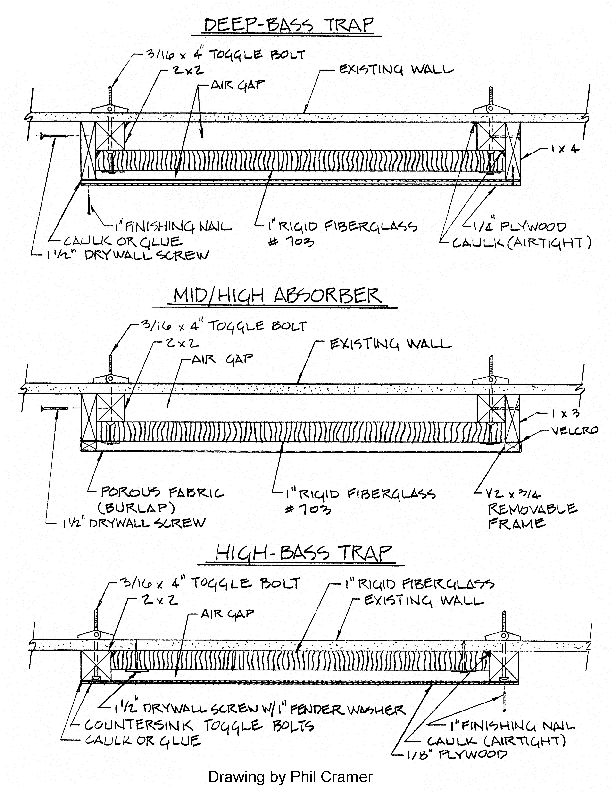
Aaaand back to the absorbers: Should I just forget about them and use the space for something else, or should I have a go? And if so: How? What would be my best bet? There are loads of different absorber types, and so far I've only found solid info on the actual construction (size, build, etc as related to specific freq areas) when it comes to the Helmholz type. I've looked at Ethans site and his writings about panel absorbers and the drawings there, and it's all a bit vague to me (again, I'm stupid). There's a drawing there of a 'Deep Bass Absorber' but it doesn't really say much about dimensions. Or the actual deepness of the thing. As far as I understand the link Kris made (to Ethans board), that's only describing the distance between the plywood and the fiberglass, and the density of the fiberglass. Surely, the actual size of the trap must mean something too? Width, depth, heigth, yaknow? Or am I missing something here?

Then there's the people saying that the best thing to do is an angled absorber, cause it'll work at a lot more frequencies. Obviously, that's a good idea, but does it actually work in real life? And again: How do I go about dimensioning it?


I know I'm asking a LOT of questions here. I wish I could come up with a good excuse for that, but I can't. It's just my lack of knowledge, really. Sigh. Sorry ...

I'll try messing about with some eq's tonight and will report back. Till then,

thank

:-)


Flemming
:?
Ethan Winer
Senior Member
Posts: 1063
Joined: Fri Feb 21, 2003 3:50 am
Location: New Milford, CT, USA
Contact:

Post by Ethan Winer »

Flemming,

> I've looked at Ethans site and his writings about panel absorbers and the drawings there ... There's a drawing there of a 'Deep Bass Absorber' but it doesn't really say much about dimensions. Or the actual deepness of the thing. <

You obviously didn't look close enough because everything is there down to the last detail. Depth, height and width, front panel thicknesses, how to mount them on the wall, parts list - everything. Did you scroll down to near the end of the article and click the link for the actual plans drawing?

--Ethan
r.baby
Posts: 11
Joined: Thu Sep 01, 2005 4:11 am
Location: Denmark

Post by r.baby »

Ethan Winer wrote:Flemming,

> I've looked at Ethans site and his writings about panel absorbers and the drawings there ... There's a drawing there of a 'Deep Bass Absorber' but it doesn't really say much about dimensions. Or the actual deepness of the thing. <

You obviously didn't look close enough because everything is there down to the last detail. Depth, height and width, front panel thicknesses, how to mount them on the wall, parts list - everything. Did you scroll down to near the end of the article and click the link for the actual plans drawing?

--Ethan

Hi Ethan,

Err, yes I think so. This link, right? http://www.ethanwiner.com/BTPlans.gif

It doesn't really say anything about the size of the plywood, which I take it is the defining factor when it comes to the attack freqency and q. Or am I blind? I'm not trying to be pedantic or anything, I just don't see the info, seriously.

bewilderedly yours,

;-)

Fl.
r.baby
Posts: 11
Joined: Thu Sep 01, 2005 4:11 am
Location: Denmark

Post by r.baby »

AHA!!!

For some weird reason, I'd managed not to print out the notes at the bottom of Ethans page where it very clearly states the freq ranges of his three basstraps. My bad, sorry for the confusion!! I was actually looking more for a formula to figure out how to address the low (loooow) end probs ...

Anyway! The low one seems to fit my 100ish hz probs quite perfectly. I'll build one next week and see how it goes. Any suggestions on placement? If I take Steve up on his word an fill the corner behind the right speaker with rigid fiberglass, would the right sidewall be the better bet for a Deep Bass Trap, Ethan-style, or should I put it under the control room window? Also, will one suffice? Given the free space on the side wall and under the window, I suppose there is room for a few ...

best regards,

Fl.
Post Reply