Acoustic Measurement Primer

How to use REW, What is a Bass Trap, a diffuser, the speed of sound, etc.

Moderators: Aaronw, sharward

kendale
Moderator
Posts: 1667
Joined: Tue Aug 10, 2004 8:10 pm
Location: Hawaii

Acoustic Measurement Primer

Post by kendale »

Aloha,

In light of a recent post in which the topic of acoustic measurements came up, I (for one) would like to learn more about the process in one dedicated thread rather than in bits and pieces that I've so far managed to pick up, and perhaps this might prove useful for others as well, perhaps a s sticky/reference topic.

While I've done basic RTA measurements, I have gathered that there are other measurements that can be taken that are more extensive. I would like to learn the proper way to take those measures and also how to interpret the data produced (like those interesting waterfall/3D type graphs I've seen posted) and which software programs and equipment are necessary and recommended. (I've read the info at the ETF site, but am still not sure what all it means, and would sure appreciate some help :D )

Thank you in advance,

Aloha 8)
Ethan Winer
Senior Member
Posts: 1063
Joined: Fri Feb 21, 2003 3:50 am
Location: New Milford, CT, USA
Contact:

Re: Acoustic Measurement Primer

Post by Ethan Winer »

Ken,

> I would like to learn the proper way to take those measures and also how to interpret the data produced (like those interesting waterfall/3D type graphs I've seen posted) <

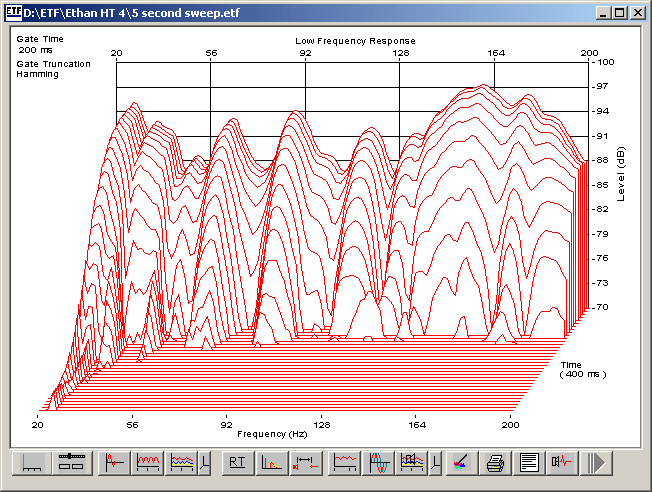
I use ETF, and its newer replacement R+D, and both do a great job. Waterfall plots are not too complicated once you know what they're showing. This graph is of my living room:

Image

The "back wall" of the graph is the raw low frequency response. You can see the peaks and nulls clearly, though this room is a lot flatter than most.

Each peak is also accompanied by modal ringing. When a sound occurs at one of the modal frequencies the room continues to ring, like a bell, for some time even after the original sound stops. The ringing is shown by the "mountains" that come forward over time. So in this graph you can see that for all but the very lowest frequencies, ringing has pretty much died out within a few hundred milliseconds.

--Ethan
David French
Posts: 118
Joined: Sun Feb 05, 2006 3:09 pm
Location: Indiana

Post by David French »

To aid in the understanding of waterfall plots, look at this image.

Image

The blue curve is earlier in time than the green curve. The fact that the green curve shows the same peaks as the blue curve demonstrates that these peaks are due to a resonance. The green curve represents a moment in time after the speaker has been shut off.

A waterfall plot is essentially the same thing as the type of plot above, but it shows many 'slices' (moments in time) on a three dimensional grid. Itis just another way of looking at the data in the first graph. These type of plots are useful for seeing resonances - energy that carries on after the speaker has been shut off. In contrast to what Ethan has posted, here is the waterfall reponse of a typical bedroom studio that is completely empty.

Image

The four big peaks are axial modes associated with the length, width, height, and then the second length mode. This graph represents 30 dB of decay, and as you can see, some of them haven't even reached -30 dB in 400 msec of time. The strongest of these modes down not reach -60 dB until 1,400 msec, or 1.4 seconds! Quite powerful indeed.

Waterfall plots like these can also be used in the high frequency range for showing speaker defects such as cone resonances.

More later.
David M. French
kendale
Moderator
Posts: 1667
Joined: Tue Aug 10, 2004 8:10 pm
Location: Hawaii

Post by kendale »

Aloha Ethan & David,

Cool! Thank you for taking the time to explain that so clearly. I love learning this stuff and am looking forward to the next installment!

And if I may, after we get some of the basic groundwork laid, would it be possible to:

#1 detail how to hook up the necessary mics/meters/etc that would be necessary for me to start doing these types of measurements.

#2 walk me through the process of measuring my room, where & why to place the mic, and what to do with the data produced.

Again, thank you to both of you :D

Aloha 8)
kendale
Moderator
Posts: 1667
Joined: Tue Aug 10, 2004 8:10 pm
Location: Hawaii

Post by kendale »

Aloha,

Just reading through the ETF site and was wondering what are MLS measurements?
ETF software is a highly accurate PC based acoustic measurement system designed to meet the needs of both hi fi enthusiasts and professionals. Two channel MLS measurements provide accurate results with even low cost standard pc sound cards.

ETF can be used with a test signal CD and half duplex (record only) sound cards for portable measurement capability for laptop computers. This wireless solution may also work for PC emulators.

MLS/Sweep based frequency response measurement
0 - 3 sec RT/60 Measurement
Filtered Energy / Time Curves (Envelope)
Two Channel Measurement (eliminates sound card freq resp. error)
Pseudo Real Time Operation
SPL & Mic Response Calibration
Easy multiple measurement comparison
Ease of use & setup testing
1/2....1/12 Octave Response
Aloha 8)
kendale
Moderator
Posts: 1667
Joined: Tue Aug 10, 2004 8:10 pm
Location: Hawaii

Post by kendale »

Aloha,

Found it: Maximum Length Sequence

Aloha 8)
len-morgan
Senior Member
Posts: 657
Joined: Wed Aug 10, 2005 8:02 am
Location: Big Spring, TX, USA

Post by len-morgan »

In my thread, Step by Step Studio Tuning, I was hoping to cover this subject with "real" rooms and data. The idea was to start with my bare rooms and ETF and then as I try/add each treatment, put up the resulting new graphs so people could see how the rooms change with each treatment.

Unfortunately, I'm running a little behind in my building (too much time here), so it hasn't really taken off yet. Perhaps the two threads can be complimentary in that this one could be theoretical and mine could be actual.

len
Ethan Winer
Senior Member
Posts: 1063
Joined: Fri Feb 21, 2003 3:50 am
Location: New Milford, CT, USA
Contact:

Post by Ethan Winer »

David,

Great stuff, I liked it all, especially this explanation:
The blue curve is earlier in time than the green curve ... energy that carries on after the speaker has been shut off.
> The four big peaks are axial modes associated with the length, width, height, and then the second length mode. <

Yep, and that just goes to show how important axial modes are compared to those "other" modes. :D

--Ethan
Post Reply