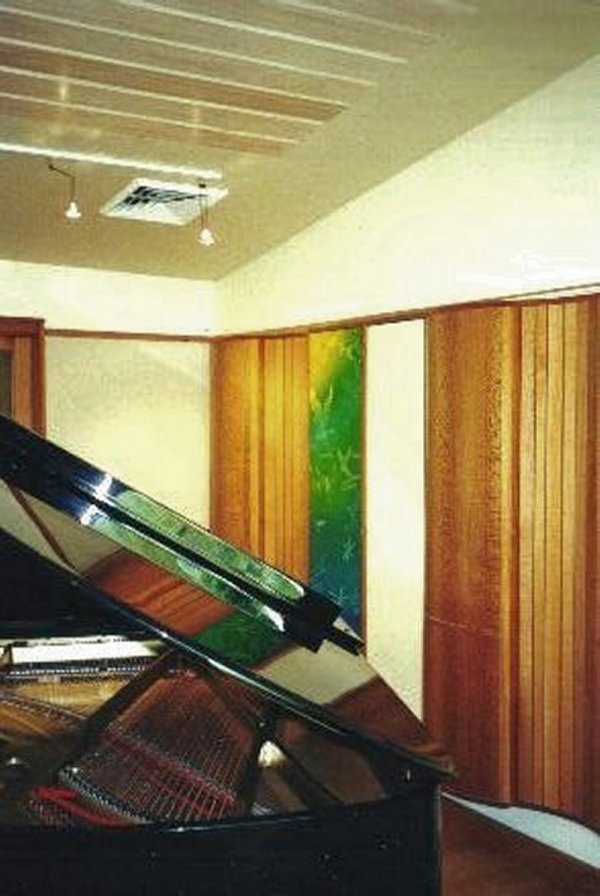
ah - quick swallow, gulp!! well as you may have noticed I don't generally use panel absorbers. why?? because they don't offer 'value for wall space' IMHO. I don't wish to be dismissive of what Ethan proposes but if you read up on panel absorbers they go way back to original BBC style acoustics....so do slots..in fact both are original - pre 70's classic acoustic solutions.
I remember a studio at film australia built in the 60's.It was a big room maybe 60' x 40' with all these 2 x 2 boxes on the wall. Each was either a panel absorber or a perforated hole slot absorber or just a high frequency insulation absorber. For the levels they had at the time it appeared to work but I wouldn't have wanted to record Deep Purple in there.
Whilst this room was cool for it's day but it couldn't handle the high SPL levels of the loud rock bands of the 70's. A new acoustic was required hence the deep trap aka Hidley bass traps with acoustic hangers.
These provided a more intense absorption and managed to withstand the onslaught of the Marshall turned up to 11.

If you read the BBC documentation on panel absorbers
http://www.bbc.co.uk/rd/pubs/reports/ you will see that they were very frequency dependent, in fact you could tune them to specific frequencies. For Ethan to claim they are broadband defeats the whole science of how they work IMO. Sorry Ethan no offense intended - you may reply
In a studio I worked in in the early 70's we had panel absorbers designed for us by the acoustics lab from Sydney Uni. They built a wall of 2 x 2 x 4 frames and placed various panels of differing thickness and mass over each to provide a broad band low end absorber. For me to have three different thicknesses over a 2 x 8 frame and claim broadband is pushing it
I'm happy for Ethan to inform me and prove me wrong but that's my take on it anyway
cheers
John